
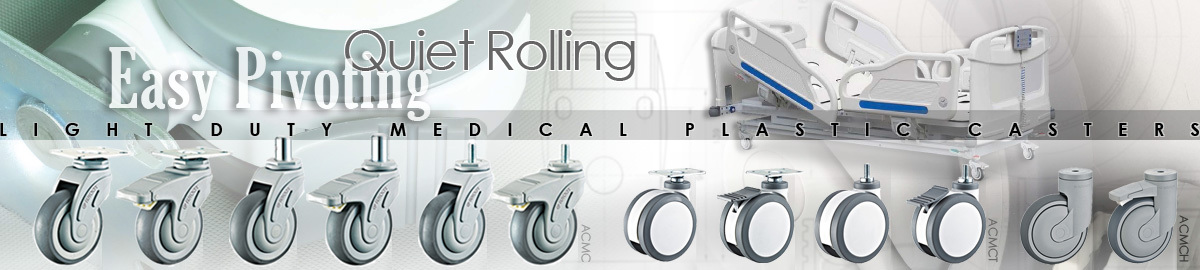
Medical plastic casters are light-duty swivel casters built around a plastic frame, a plastic wheel core and a TPR or PA + PU wheel, with a zinc-treated steel top plate and bolt on the flange and stem models. Carrymaster lists hospital beds, medical devices and light-load trolleys and carts as their applications, and describes the line as easy pivoting and quiet rolling, with a light, corrosion-resistant structure.
Zambus carries 30 Carrymaster medical plastic casters in three series: the single-wheel ACMC, the twin-wheel ACMCT and the single-wheel ACMCH. Ratings run from 132.28 lbs to 297.62 lbs per caster, in three wheel sizes, and every model comes with or without a brake.
| Series | Wheel | Size codes | Load per caster | Mounts | Wheel material | Frame |
|---|---|---|---|---|---|---|
| Carrymaster ACMC Series | Single | 76, 102, 127 | 198.42 to 297.62 lbs | Flange or stem; round stem on 102 and 127 | TPR on a PP core | PA6 |
| Carrymaster ACMCT Series | Twin | 76, 102, 127 | 132.28 to 220.46 lbs | Flange or stem | PA + PU on an ABS (76, 102) or nylon (127) core | ABS (76, 102), nylon (127) |
| Carrymaster ACMCH Series | Single | 127 | 198.42 lbs | Swivel with a hole (see the product drawing) | TPR on a PP core | PA6 |
At every size code, the single-wheel ACMC is rated higher than the twin-wheel ACMCT: 198.42 against 132.28 lbs at 76, 264.55 against 176.37 lbs at 102, and 297.62 against 220.46 lbs at 127. The ACMC-127 is the highest-rated caster in the line.
So an ACMC-102SFB is a single-wheel ACMC, size 102, swivel flange, with brake. Stem threads, plate holes and caster heights are on the dimension drawing on each product page.
For a side-by-side walk through all 30 models, read the Carrymaster medical plastic casters series guide. Replacing casters on an existing cart? Start with how to replace casters on a medical cart.
All the Carrymaster medical plastic casters we carry are in stock and ready to ship from New Jersey, and every model is sold individually. To match a caster to your equipment, call our Casters and Wheels Experts at (973) 777-4922.
A. Yes. Hospital beds are among the applications Carrymaster lists for this line, alongside medical devices and light-load trolleys and carts. All 30 models are light duty, rated from 132.28 to 297.62 lbs per caster, so size from the bed's full weight with the patient and accessories, using the per-caster method in our guide to caster wheel load capacity.
For what else a bed caster has to do, including braking and cleanability, read our guide on how to choose hospital bed casters.
A. The Carrymaster product pages for this line do not list a certification. What they publish for every model is the load per caster, the material of each part and a dimension drawing.
Requirements for a finished medical device are set by the device's maker and the standards it is built to, so confirm with them what the caster has to meet. If your project needs documentation for a specific model, call us before you order.
A. Start from the load, not the wheel. Within each series the rating rises with the size: the ACMC goes from 198.42 lbs per caster at size 76 to 297.62 lbs at size 127, and the ACMCT from 132.28 to 220.46 lbs.
Choose the smallest size whose rating covers your load per caster, then check the caster height on the product page drawing against the space under the cart. When you replace casters, matching the old size keeps the cart at its current height.
A. For the Carrymaster medical line, replace the whole caster rather than the wheel. Zambus sells these models as complete casters, and the loose wheels in our Wheels and Parts category are not listed for the medical series.
A complete caster comes with its own swivel and, on the B models, its own brake. Match the mount on your cart, then follow our guide on replacing casters on a medical cart.
A. Zambus, Inc. is based in Palisades Park, New Jersey, and carries the full Carrymaster medical plastic caster line: 30 models across the ACMC, ACMCT and ACMCH series. Every product page shows the load per caster, the materials and a dimension drawing.
To talk to someone before you order, call our Casters and Wheels Experts at (973) 777-4922 or email sales@zambus.com.
A. Compare what each supplier publishes for the exact model, not the category label: the load rating per caster, the material of the wheel, wheel core, frame and top plate, a dimension drawing, and whether the model comes with and without a brake.
Then check that stock is shown before you order and that someone will help you match a model. The Zambus product pages for the Carrymaster medical line show each of these.
A. Usually not. Leveling casters are made for equipment that is rolled into place and then parked on its feet. A cart that moves all day needs swivel casters.
A cart that wobbles or drags is more often running on worn casters, or on casters rated below the load they carry. Check the load per caster against the rating, then replace the worn casters with a model whose rating covers it.
A. It can be, so check capacity and stability separately. For capacity, work out the required load per caster and compare it with the rating, as explained in our guide to caster wheel load capacity.
For stability, a tall cart standing on casters set close together can tip when one wheel stops at a threshold or a cord, whatever the rating. A higher-rated caster does not lower the center of gravity; a wider caster footprint and slower pushing over thresholds help.
A. Replace a caster when the wheel tread is cracked, chunked or flat-spotted, when the swivel wobbles or binds, when the wheel no longer turns freely, or when a brake no longer holds the equipment still.
How fast casters wear depends on distance travelled, load carried and cleaning exposure. Our article on when to replace hospital bed casters covers the signs in more detail.
A. On lab carts, yes, within the rating: Carrymaster lists light-load trolleys and carts among the applications, and the line runs from 132.28 to 297.62 lbs per caster.
For a lab bench or an instrument that stays in one place for long periods, look at leveling casters, which roll the equipment into position and then hold it on a foot.